Full-Day Dialogue with High-Level Judges on Climate Law and Science

Access resource
On 9 December, CLX and the Global Judicial Institute on the Environment (GJIE) co-hosted the “Dialogue on the Latest Scientific and Legal Developments in Climate Change Law” with Justices of the Supreme and Constitutional Courts of Belgium, Brazil, Kenya, Nepal, Pakistan, and South Africa, as well as other experts in the field.
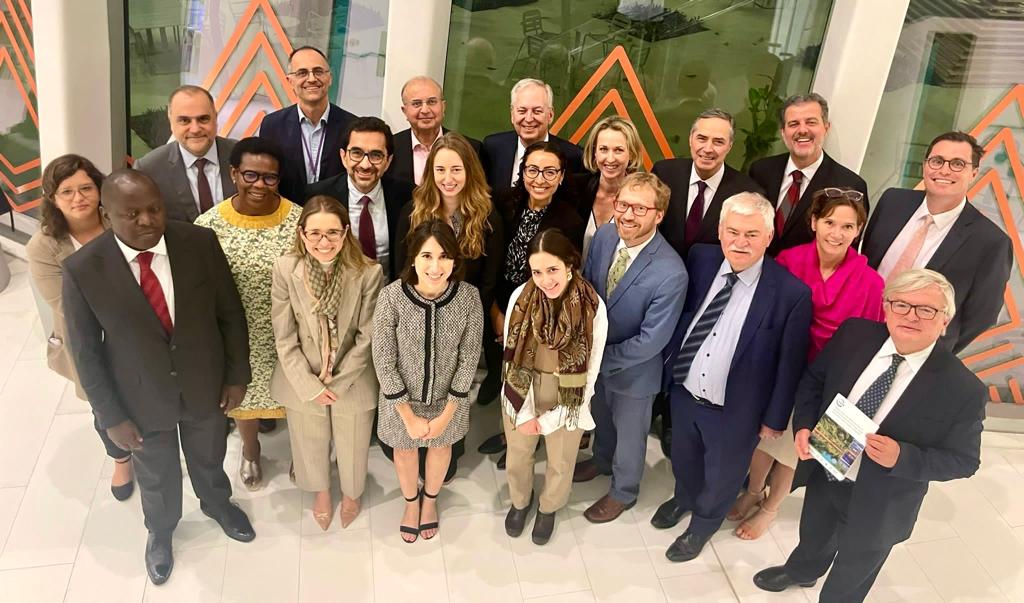
Participants of the Dialogue from left to right, back to front: Juliana Almeida (UNEP); Justice Leonardo Nemer Caldeira Brant (ICJ); Professor Pavlos Eleftheriadis (NYUAD); Justice Syed Mansoor Ali Shah (Supreme Court of Pakistan); Ambassador Luiz Alberto Figueiredo Machado (Brazil); Professor Aude Solveig Epstein (NYUAD); Chief Justice Luís Roberto Barroso (Supreme Court of Brazil); José Gilberto Scandiucci Filho (Supreme Court of Brazil); Andy Raine (UNEP); Justice Oscar Amugo Angote (Environment and Land Court of Kenya); Justice Nambitha Dambuza (Supreme Court of Appeal of South Africa); Professor César Rodríguez-Garavito (NYU Law); Dr. L. Delta Merner (Union of Concerned Scientists); Ashley Nemeth (NYU Law); Professor Nicholas Bryner (GJIE); Chief Justice Luc Lavrysen (Constitutional Court of Belgium); Professor Christina Voigt (IUCN World Commission on Environmental Law); Justice Antonio Herman Benjamin (High Court of Brazil; GJIE President); Professor Melina De Bona (NYU Law); Jacqueline Gallant (NYU Law). Chief Justice Martha K. Koome (Supreme Court of Kenya); Justice Sapana Pradhan Malla (Supreme Court of Nepal); and Rose Wachuka Macharia (Chief of Staff, Supreme Court of Kenya) also attended the event.

The day-long dialogue fostered conversations on existing climate and environmental jurisprudence, emerging legal doctrines, and current climate science. The event was held at NYU’s Abu Dhabi campus and counted with the support of the UN Environment Programme (UNEP), the Union of Concerned Scientists, the International Association of Judges, World Commission on Environmental Law, the International Council of Environmental Law and the European Union Forum of Judges for the Environment. 

Justice Leonardo Nemer Caldeira Brant (ICJ) and Chief Justice Luís Roberto Barroso (Supreme Court of Brazil) engage during the Dialogue’s session “Climate Law Developments – Looking Forward”.
Chief Justice Luc Lavrysen (Constitutional Court of Belgium) presents in the Dialogue’s session “Global Overview of Climate Jurisprudence: Cases, Doctrines, and Remedies.”

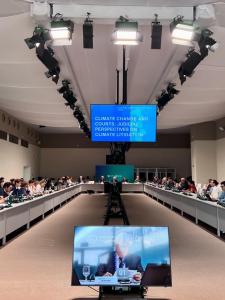
On 10 December, CLX partners — the GJIE and UNEP — carried many of the ideas from the prior day’s Dialogue into COP-28. CLX attended and supported the official event “Climate Change: Judicial Perspectives on Climate Litigation.” This high-level dialogue between Supreme Court and Constitutional Justices, as well as climate experts explored approaches and solutions to climate change-related disputes. This event marked the first time that senior judges held an official event at a climate COP.
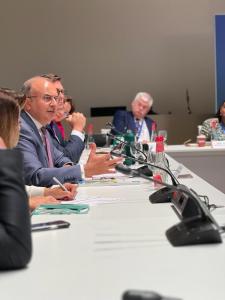
Justice Syed Mansoor Ali Shah (Supreme Court of Pakistan) presents at COP-28 event “Climate Change: Judicial Perspectives on Climate Litigation.”
Justice Antonio Herman Benjamin (High Court of Brazil; GJIE President) opens the event “Climate Change: Judicial Perspectives on Climate Litigation.
Chief Justice Martha K. Koome (Supreme Court of Kenya) presents at COP-28 event “Climate Change: Judicial Perspectives on Climate Litigation.”

Highlights

Yes. CLX resources are open-access and may be cited with attribution. If you plan to reproduce substantial portions of the text or figures, please reach out to our team first.

Reports and working papers go through internal review by CLX researchers and, where noted, external subject-matter experts. Educational materials and commentary are reviewed for accuracy but are not formally peer-reviewed academic publications.

Climate litigation moves quickly, and case law referenced here reflects the state of play at the time of publication. Where a resource is part of an ongoing series or learning kit, later installments may reflect more recent developments.

Absolutely — many of our resources, including learning kits and video series, are designed for classroom and clinic use. Non-commercial educational use is encouraged; contact us for permissions on commercial training programs.

You might also like

Articles

Loss & Damage Hub

Helping impacted communities, advocates, and decision-makers address the loss and damage caused by climate change.
Books

Climate Change on Trial

From landmark court decisions to emerging legal strategies, explore two decades of rights-based climate litigation through a comprehensive learning platform. Start with the free Coursera course, explore in-depth and digestible video explainers, or download the open-access Climate Change on Trial book in English, Spanish, or Portuguese.
Cape High Court in Cape Town, frontal view. Established in 1828.
Articles

Addressing the Climate Emergency: The Untapped Potential of South African Constitutional Law

How can South African constitutional law strengthen climate litigation? This article examines cases challenging fossil fuel projects, identifies gaps in litigation over climate policy and adaptation, and explores the potential of environmental rights, socioeconomic rights, and corporate accountability.