Gold Mining and Violence in the Amazon Rainforest

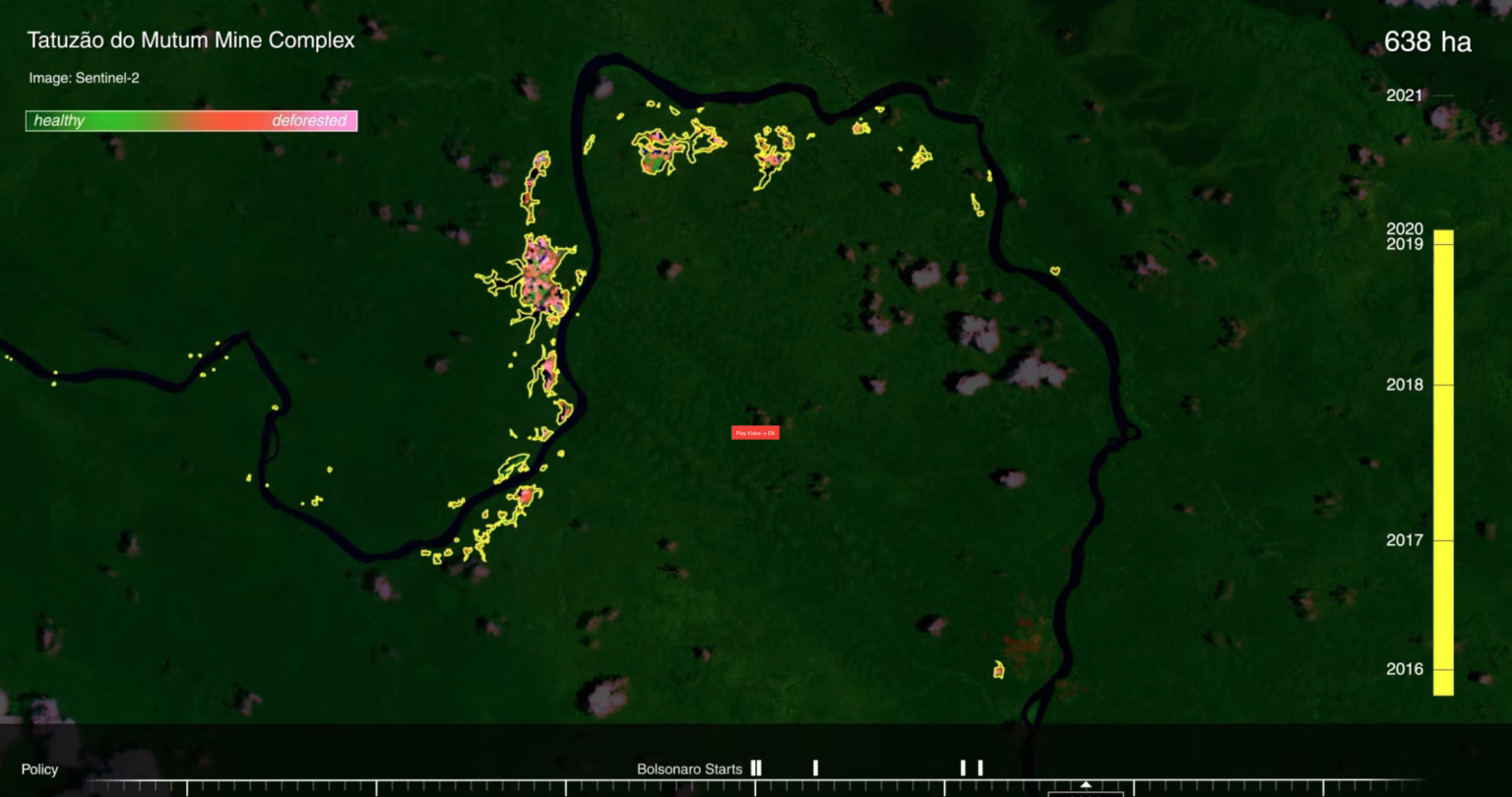
Based on work supported by Stitching Foundation for International Law for the Environment (FILE), through a grant to CLX, Forensic Architecture investigated the expansion of illegal gold mining in Yanomami territory in Brazil’s Amazon rainforest. Combining satellite imagery, policy analysis, and reconstructions of attacks on a Yanomami village, the project traces how forest destruction and violence unfolded alongside policies adopted under the Bolsonaro administration.
Forensic Architecture

Based on work supported by Stitching Foundation for International Law for the Environment (FILE), through a grant to CLX, Forensic Architecture investigated illegal gold mining in Yanomami territory along the Uraricoera River in northern Brazil. The project examines three connected developments: policies adopted under the Bolsonaro administration, violent attacks on Yanomami villages, and environmental destruction associated with the expansion of mining.

The investigation analyzes policies and actions that its researchers identified as encouraging mining on Indigenous land and weakening protections for the forest. These included weakening and defunding environmental protection agencies, reducing fines for environmental crimes, and attempting to legalize mining on Indigenous land. The project places these actions on a timeline alongside changes in mining activity and reported attacks.

Using satellite imagery, geographic analysis, and remote sensing, the investigation mapped mines along the Uraricoera River and tracked their growth between 2016 and 2022. It found that mining expanded by approximately 500 hectares in the three years before Bolsonaro took office and by a further 1,000 hectares in the following three years. The analysis also identified eight examples in which illegal airstrips closely preceded nearby mining growth.

To examine violence against Yanomami communities, the team mapped reported attacks along the river and reconstructed two attacks on the village of Palimiu on May 10 and 11, 2021. A three-dimensional model helped locate footage of boats passing the village and place those incidents within a broader timeline of attacks. Satellite analysis also documented mining near Yanomami villages and visible runoff from a mine complex near Aracaca.

By bringing policy records, spatial evidence, and accounts of violence together, the investigation makes patterns across a remote territory easier to see. Its findings underscore the importance of Yanomami territorial rights to the protection of communities and of a rainforest vital to the climate.

This material is based on work supported by Stichting Foundation for International Law for the Environment (FILE), through a grant to New York University (NYU). Any opinions, findings, and conclusions are those of the authors and do not necessarily reflect the views of FILE or NYU.

Highlights

The investigation examines the expansion of illegal gold mining in Yanomami territory along the Uraricoera River in Brazil’s Amazon rainforest. It asks how mining and the destruction it caused unfolded alongside policies adopted under the Bolsonaro administration and violent attacks on Yanomami communities. CLX and Forensic Architecture studied these developments together to reveal patterns that can be difficult to see when each incident is considered separately.

The project combines analysis of government policies with satellite imagery, geographic mapping, remote sensing, timelines of reported attacks, and three-dimensional reconstruction. These methods allow the investigation to compare changes in mining activity over time, locate mines in relation to Yanomami villages, and examine footage of attacks in its physical setting. The published investigation presents its findings through maps, images, video, and written analysis.

The investigation found that mining expanded by approximately 500 hectares in the three years before 2019 and by a further 1,000 hectares in the following three years. In other words, the rate of expansion doubled during the period examined after Bolsonaro took office. The comparison concerns the mining areas mapped along the Uraricoera River; it is not an estimate of all mining across the Amazon.

The investigation identifies four approaches taken under the Bolsonaro administration that its researchers say supported illegal gold mining and undermined Indigenous sovereignty: weakening environmental protection agencies, reducing their funding, lowering fines for environmental crimes, and attempting to legalize mining on Indigenous land. It compares the timing of these actions with mapped deforestation and attacks on Yanomami communities.

The team examined attacks on Palimiu on May 10 and 11, 2021, using a three-dimensional model to situate available footage of boats moving past the village. It also placed those incidents in a timeline of attacks on Palimiu and other Yanomami communities along the river. The reconstruction helps show where and how the recorded incidents occurred and how they relate to a wider pattern of violence reported in the territory.

Airstrips can provide access to remote mining sites. The satellite analysis found eight examples in which an illegal airstrip closely preceded nearby mining growth in Yanomami territory. The investigation treats this pattern as a potential indicator of new mining activity and future deforestation, giving researchers and advocates a way to identify areas that may warrant closer attention.

The investigation maps forest cleared by mining, the proximity of mines to Yanomami villages, and visible runoff from a mine complex near Aracaca. It raises concern that runoff may carry toxic mercury used in gold mining, although satellite imagery alone cannot establish the runoff’s chemical contents. The documented forest loss also matters for the climate: protecting the Amazon rainforest and the Indigenous territories within it helps preserve an ecosystem that plays a critical role in regulating the climate.

The investigation may be useful to Yanomami organizations and their allies, Indigenous rights and environmental advocates, researchers, journalists, and policymakers examining illegal mining in the Amazon. Its maps, timelines, and reconstructions provide ways to review the relationship among policy decisions, changes to the land, and attacks on communities. They also illustrate how visual and spatial methods can help document harms in areas where on-the-ground reporting is difficult and dangerous.

Yes. CLX resources are open-access and may be cited with attribution. If you plan to reproduce substantial portions of the text or figures, please reach out to our team first.

Reports and working papers go through internal review by CLX researchers and, where noted, external subject-matter experts. Educational materials and commentary are reviewed for accuracy but are not formally peer-reviewed academic publications.

Climate litigation moves quickly, and case law referenced here reflects the state of play at the time of publication. Where a resource is part of an ongoing series or learning kit, later installments may reflect more recent developments.

Absolutely — many of our resources, including learning kits and video series, are designed for classroom and clinic use. Non-commercial educational use is encouraged; contact us for permissions on commercial training programs.

You might also like

Articles

Loss & Damage Hub

Helping impacted communities, advocates, and decision-makers address the loss and damage caused by climate change.
Books

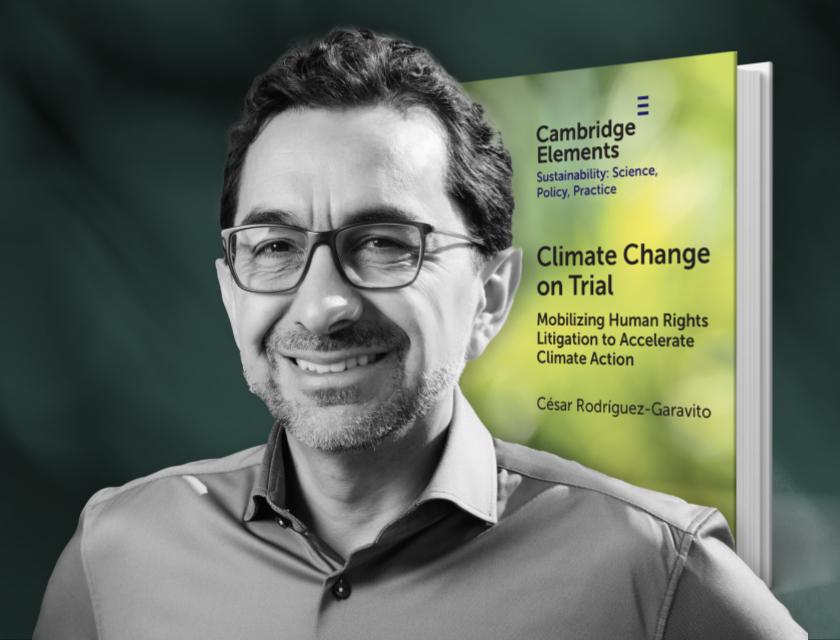
Climate Change on Trial

From landmark court decisions to emerging legal strategies, explore two decades of rights-based climate litigation through a comprehensive learning platform. Start with the free Coursera course, explore in-depth and digestible video explainers, or download the open-access Climate Change on Trial book in English, Spanish, or Portuguese.
Cape High Court in Cape Town, frontal view. Established in 1828.
Articles

Addressing the Climate Emergency: The Untapped Potential of South African Constitutional Law

How can South African constitutional law strengthen climate litigation? This article examines cases challenging fossil fuel projects, identifies gaps in litigation over climate policy and adaptation, and explores the potential of environmental rights, socioeconomic rights, and corporate accountability.